lets hearing a music !

Rabu, 14 Maret 2012

Identity


Catalunya 


FC Barcelona is “more than a club” in Catalonia because it is the sports club that most represents the country and is also one of its greatest ambassadors
The slogan “more than a club” is open-ended in meaning. It is perhaps this flexibility that makes it so appropriate for defining the complexities of FC Barcelona’s identity, a club that competes in a sporting sense on the field of play, but that also beats, every day, to the rhythm of its people’s concerns. 

Also, for different reasons, FC Barcelona is “more than a club” for many people living elsewhere in Spain, who see Barça as a staunch defender of democratic rights and freedom. 

Today, football has become a global phenomenon, and support for Barcelona has spread spectacularly around the world. The number of club members from outside of Catalonia and Spain is increasing daily, and the club wants to respond to that show of passion for Barça. This has developed into a need and an obligation. And the best way for the club to do that has been to take a step further and become “more than a club around the world” as well. This Barça that is so concerned for its people needs to be globalised. This caring and humanitarian Barça needs to be globalised. It is a strategic decision that is in keeping with the club’s history and the way that football is continuing to develop on a worldwide basis. 

That is why the club has decided to contribute 0.7 per cent of its ordinary income to the FC Barcelona Foundation in order to set up international cooperation programmes for development, supports the UN Millennium Development Goals and has made a commitment to Unicef’s humanitarian aid programs through the donation of one and a half million euros for the next five years and now wears the Unicef logo on its shirts.
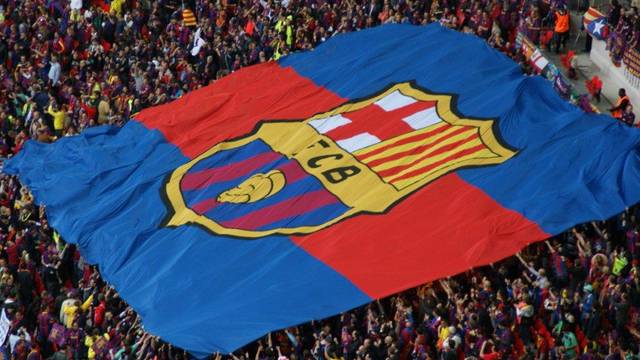
More than a club!


Més que un Club, Bandera FC Barcelona


The slogan ‘més que un club’ (‘more than a club’) was coined
 on an exact date and by a particular person. It was president 
Narcís de Carreras, in his presidential acceptance speech 
in January 1968 who was the first person to use these words 
to describe the social importance of FC Barcelona in Catalonia.
 And, a few year later, in 1973, in his campaign for re-election to 
the club presidency, Agustí Montal i Costa gave it its definitive 
form when he adopted it during his election campaign.
 Barça is “quelcom més que un club de futbol” (“something more
 than a football club”), was the slogan used in the build up to 
the elections that were eventually won by Lluís Casacuberta.

GAMPER, THE KEY


At the same time, the roots of ‘more than a club’ go back much 
further. It was an idea first induced by club founder Joan Gamper 
during his first presidency in 1908. The period when Gamper took 
the reigns of the club, thus avoiding its dissolution at a dramatic
 assembly, is well documented. In fact, Gamper’s gesture to 
save the club from closure has often overshadowed his other 
great deed of the time. On that famous December 2, 1908,
 given the collective desertion, Gamper stood up to say “Barcelona 
cannot and should not die. If there is nobody who wants to try, I shall 
take full responsibility and look after it in the future.” 

Gamper, who had founded the club, was now going to save it from 
disappearing. But more important for the future of the club was they 
way he wanted to run it. To the original reason why the club was founded,
 that of doing sport, he added another: for it to be a pro-Catalan club
 and actively serve its country. And so it was that the club approached
 the most actively pro-Catalan political sectors and had no doubts 
about coming out in defence of the identity and national rights of Catalonia,
 whether than be in support of the ‘Autonomy of the Commonwealth’ or
 to bring the Olympic Games to Barcelona. 

The ‘sport and citizenship’ programme created by the executed president
 Josep Sunyol during the years of the Republic or the actions of president 
Agustí Montal in leading FC Barcelona to support the 1977 campaign for a
 Statute of Autonomy and to invite the restored president of the Generalitat, 
Josep Tarradellas, to the Camp Nou just a few days after his return from exile,
 were just a few of the practical applications of the idea of being
 'més que un club' (‘more than a club’).

WRITTEN INTO THE CLUB STATUTES

The spirit that Gamper injected into FC Barcelona from 1908 (the year
 when it could be said that the club was ‘refounded’), has survived to 
this day and is even present in the current club statutes. It is article 4, 
describing the functions of the club, which states that the second 
objective is “complementarily, the promotion and participation in social, 
cultural, artistic, scientific or recreational activities that are adequate 
and necessary for maintaining the public representation and projection that 
the club enjoys, the fruit of a permanent tradition of loyalty and service
 to club members, citizens and Catalonia”.

'MÉS QUE UN CLUB' (‘MORE THAN A CLUB’) IN SPAIN


For different, but not contradictory, reasons, for many people living in the 
rest of Spain, FC Barcelona has also been seen as being 'més que un club'
 (‘more than a club’). If in the Catalan case the starting point can be dated 
to a deliberate decision made by the directors, or better put, that of its 
president Joan Gamper, in the Spanish case this movement came
 from below. It was the intellectual classes and left wing politicians
 that become Barça supporters in recognition of its role in defending
 democratic rights and freedom. 

This movement reached its peak during the Spanish Civil War and under
 the Franco regime. There were some particularly poignant episodes,
 such as the tour of America, in which the team was received as
 ambassadors of the Republic, or the tram strike in 1951, with received the 
support of Barcelona fans much to the surprise of the Francoist authorities 
who could not understand why, on that Sunday in the pouring rain, the fans left 
Les Corts stadium after beating Santander 2-1 and refused to catch any trams. 
It is moments like these that show how FC Barcelona represents much more
 than just Catalonia for so many forward-thinking Spaniards. 

The Franco regime explains much of the extension of 'més que un club' (more 
than a club’) to the rest of the Spanish territory. But it also goes back even further
 than that. Certain Spanish intellectuals had already alluded to the club back in 
the twenties, such as poet Rafael Alberti, whose 'Ode to Platko' is the prime
 example. Others used the figure of Josep Samitier, another of the key people
 for understanding the way that FC Barcelona managed to reach much further
 than its natural sphere of influence.


Tidak ada komentar:

Posting Komentar