


Formed: 1899
Nicknames: Azulgrana (Blue and Reds, Spanish), Blaugrana (Blue and Reds, Catalan)
Nicknames: Azulgrana (Blue and Reds, Spanish), Blaugrana (Blue and Reds, Catalan)
UEFA club competition honours (runners-up in brackets)
• European Champion Clubs' Cup: 1992, 2006, 2009, 2011; (1961), (1986), (1994)
• UEFA Cup Winners' Cup: 1979, 1982, 1989, 1997; (1969), (1991)
• UEFA Super Cup: 1992, 1997, 2009; (1979), (1982), (1989), (2006)
• European Champion Clubs' Cup: 1992, 2006, 2009, 2011; (1961), (1986), (1994)
• UEFA Cup Winners' Cup: 1979, 1982, 1989, 1997; (1969), (1991)
• UEFA Super Cup: 1992, 1997, 2009; (1979), (1982), (1989), (2006)
Domestic honours (most recent triumph in brackets)
• League title: 21 (2011)
• Spanish Cup: 25 (2009)
• League title: 21 (2011)
• Spanish Cup: 25 (2009)
History
• Swiss businessman Hans Gamper founded FC Barcelona after placing an advert in a local sports magazine following his arrival in the city. Several football enthusiasts responded to Gamper's notice looking for players and the club held its first official meeting on 29 November 1899. Barça lost their first game 1-0 to a team of English expatriates.
• Swiss businessman Hans Gamper founded FC Barcelona after placing an advert in a local sports magazine following his arrival in the city. Several football enthusiasts responded to Gamper's notice looking for players and the club held its first official meeting on 29 November 1899. Barça lost their first game 1-0 to a team of English expatriates.
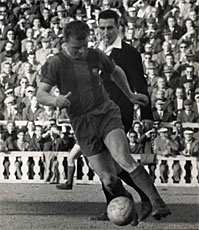
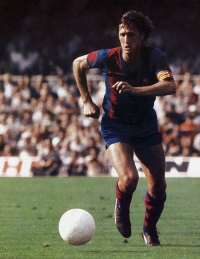
• The 1950s brought a surge in popularity – not to mention Liga titles Nos5, 6 and 7 – thanks to the likes of Ladislau Kubala, Estanislao Basora and César Rodríguez. In September 1957 Barça moved to what is now known as the Camp Nou but it was the arrival of Johan Cruyff in 1973 that heralded a new beginning for the club. Along with star turns Carles Rexach, Juan Manuel Asensi and Hugo Sotil, Cruyff immediately won the Liga title.
• Johan Neeskens and Hans Krankl were influential as the team defeated Fortuna Düsseldorf 1895 4-3 in the UEFA Cup Winners' Cup final, Barça winning the trophy again three years later. Defeat by FC Steaua Bucureşti on penalties in the 1986 European Champion Clubs' Cup final eventually brought a return of Cruyff, this time as coach, and the Dutchman built a side that would gain fame as the 'Dream Team'.
• Barcelona won a third UEFA Cup Winners' Cup title in 1989, consecutive Liga championships between 1991 and 1994, and, in 1992, Ronald Koeman's extra-time strike secured European Cup final victory against UC Sampdoria. Sir Bobby Robson led Barça to a record-breaking fourth UEFA Cup Winners' Cup win in 1997 though a lull followed until the arrival of club president Joan Laporta in 2003.
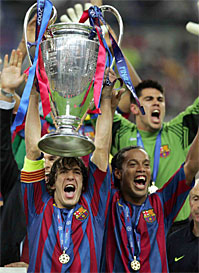
• Frank Rijkaard led the side to back-to-back Liga titles and goals from Samuel Eto'o and Juliano Belletti earned UEFA Champions League glory over Arsenal FC in 2006. Better was yet to come, however, as Josep Guardiola guided Barcelona to an unprecedented six trophies in 2009, following that up with Liga successes in 2010 and 2011. A third European Cup in five years was won with victory against Manchester United FC at Wembley in 2011.
Club recordsMost appearances: Xavi Hernández (577)*
Most goals: César Rodríguez (235)
Record league victory: Barcelona 10-1 CG Tarragona (11 September 1949)
Record league defeat: Athletic Club 12-1 Barcelona (8 February 1931)
Early years (1899-1908)
The ad in Los DeportesOn 22 October 1899 Joan Gamper placed an advert in Los Deportes declaring his wish to form a football club. A positive response resulted in a meeting at the Gimnasio Sole on November 29. Eleven players attended: Gualteri Wild, Lluís d'Ossó, Bartomeu Terradas, Otto Kunzle, Otto Maier, Enric Ducal, Pere Cabot, Josep Llobet, John Parsons, and William Parsons. As a result Foot-Ball Club Barcelona was born. Several other Spanish football clubs, most notably Real Madrid and Athletic Bilbao, also had British founders, and as a result they initially adopted English-style names.
Joan Gamper used his past to form the team. Prior to forming this club, he played for Swiss clubs like FC Basel and FC Zurich. Even with forming the colors and crest of FC Barcelona, he looked back on his past clubs. He took Basel's colors and parts for the crest to form his new club.
The ad in Los DeportesOn 22 October 1899 Joan Gamper placed an advert in Los Deportes declaring his wish to form a football club. A positive response resulted in a meeting at the Gimnasio Sole on November 29. Eleven players attended: Gualteri Wild, Lluís d'Ossó, Bartomeu Terradas, Otto Kunzle, Otto Maier, Enric Ducal, Pere Cabot, Josep Llobet, John Parsons, and William Parsons. As a result Foot-Ball Club Barcelona was born. Several other Spanish football clubs, most notably Real Madrid and Athletic Bilbao, also had British founders, and as a result they initially adopted English-style names.
Joan Gamper used his past to form the team. Prior to forming this club, he played for Swiss clubs like FC Basel and FC Zurich. Even with forming the colors and crest of FC Barcelona, he looked back on his past clubs. He took Basel's colors and parts for the crest to form his new club.
FC Barcelona quickly emerged as one of the leading clubs of both Catalonia and Spain as they competed in both the Campionat de Catalunya and the Copa del Rey. In 1901 they won their first trophy when they won the Copa Macaya and in 1902 they also played in the first Copa del Rey final, losing 2-1 to Club Vizcaya.
With Gamper's seal (1908-1923)
In 1911 Joan Gamper became club president for the first time. Gamper took over the presidency as the club was on the verge of folding. The club had not won anything since the Campionat de Catalunya of 1905 and its finances suffered as a result. Gamper was subsequently club president on five separate occasions between 1908 and 1925 and spent 25 years at the helm. One of his main achievements was to help Barça acquire its own stadium. On March 14 1909, it moved into the Carrer Industria, a stadium with a capacity of 6,000. Gamper also launched a campaign to recruit more club members and by 1922 the club had over 10,000. This led to the club moving again, this time to Les Corts, which inaugurated in the same year. This stadium had an initial capacity of 20,000, later expanded to an impressive 60,000.
In 1911 Joan Gamper became club president for the first time. Gamper took over the presidency as the club was on the verge of folding. The club had not won anything since the Campionat de Catalunya of 1905 and its finances suffered as a result. Gamper was subsequently club president on five separate occasions between 1908 and 1925 and spent 25 years at the helm. One of his main achievements was to help Barça acquire its own stadium. On March 14 1909, it moved into the Carrer Industria, a stadium with a capacity of 6,000. Gamper also launched a campaign to recruit more club members and by 1922 the club had over 10,000. This led to the club moving again, this time to Les Corts, which inaugurated in the same year. This stadium had an initial capacity of 20,000, later expanded to an impressive 60,000.
Gamper also recruited Paulino Alcántara, the club's all time top-scorer with 356 goals, and in 1917 appointed Jack Greenwell as manager. This saw the club's fortunes begin to improve on the field. During the Gamper era FC Barcelona won eleven Campionat de Catalunya, six Copa del Rey and four Coupe de Pyrenées and enjoyed its first golden age. As well as Alcántara the Barça team under Greenwall also included Sagibarbá, Ricardo Zamora, Josep Samitier, Félix Sesúmaga and Franz Platko.
Rivera, Republic and Civil war (1923-1939)
In the midst of the glorious 20's, Barca suffered of non-sporting conflicts which were to mark the following decade. On 14th June 1925, during Primo de Rivera's dictatorship, the crowd at a game in homage to the Orfeo Catalan jeered the Royal March and as a reprisal the ground closed for six months, later reduced to three, and forced Gamper to give up the presidency of the club. The club's founder, after a period of depression brought on by personal and money problems comitted suicide on July 30 1930.
In the midst of the glorious 20's, Barca suffered of non-sporting conflicts which were to mark the following decade. On 14th June 1925, during Primo de Rivera's dictatorship, the crowd at a game in homage to the Orfeo Catalan jeered the Royal March and as a reprisal the ground closed for six months, later reduced to three, and forced Gamper to give up the presidency of the club. The club's founder, after a period of depression brought on by personal and money problems comitted suicide on July 30 1930.
Although they continued to have players of the standing of Josep Escolà, the club now entered a period of decline, in which political conflict overshadowed sport throughout society. Barca faced a crisis on three fronts: financial, social, with the number of members dropping constantly, and sporting, where although the team won the Campionat de Catalunya in 1929-30, 1930-31, 1931-32, 1934-34, 1935-36 and 1937-38, success at Spanish level evaded them.
A month after the civil war began, Barça's left-wing president Josep Suñol i Garriga (a.k.a. Josep Sunyol) was murdered by Franco's soldiers near to Guadalajara. In 1937, the squad was on a tour in Mexico and USA in which the team was received as an ambassador of the fighting Second Spanish Republic. Moreover, it proved the financial saving of the club, also resulted in half the team seeking exile in Mexico and France. On 16th March 1938 the fascists dropped a bomb on the club's social club and caused serious damage. A few months later, Barcelona was under fascist occupation and as a symbol of the 'undisciplined' Catalanism, the club, now down to just 3,486 members, was facing a number of serious problems.
C. de F. Barcelona (1939-1974)
Club shield during the Franco dictatorship. After the Spanish Civil War, the Catalan language and flag were banned and football clubs were prohibited from using non-Spanish names. These measures led to the club having its name forcibly changed to Club de Fútbol Barcelona and the removal of the Catalan flag from the club shield. During the Franco era one of the few places that Catalan could be spoken freely was within the club's stadium.
Club shield during the Franco dictatorship. After the Spanish Civil War, the Catalan language and flag were banned and football clubs were prohibited from using non-Spanish names. These measures led to the club having its name forcibly changed to Club de Fútbol Barcelona and the removal of the Catalan flag from the club shield. During the Franco era one of the few places that Catalan could be spoken freely was within the club's stadium.
In 1943, at Les Corts, for the first leg of the semi-finals of the Copa del Rey against Real Madrid, the result was a 3-0 win for Barça. Before the second leg, Barcelona's players were threatened to a changing room visit from Franco's director of state security. He 'reminded' them that they were only playing due to the 'generosity of the regime'. Madrid side won that game 11-1.
Despite the difficult political situation, CF Barcelona enjoyed considerable success during the 1940s and 1950s. In 1945, with Josep Samitier as coach and players like César, Ramallets and Velasco, they won La Liga for first time since 1929. They added two more titles in 1948 and 1949. In 1949 they also won the first Copa Latina. Coach Fernando Daucik and Ladislao Kubala, regarded by many as the club's best ever player, inspired the team to five different trophies including La Liga, the Copa del Generalisimo, the Copa Latina and the Copa Eva Duarte in 1952. In 1953 they helped the club win La Liga and the Copa del Generalisimo again. The club also won the Copa del Generalisimo in 1957 and the Fairs Cup in 1958.
With Helenio Herrera as coach, a young Luis Suárez, the European Footballer of the Year in 1960, and two influential Hungarians recommended by Kubala, Sándor Kocsis and Zoltán Czibor, the team won another national double in 1959 and a La Liga/Fairs Cup double in 1960. In 1961 they became the first club to beat Real Madrid in a European Cup game, thus ending their monopoly of the competition.
The 1960s were less successful for the club, with Real Madrid and Atlético Madrid monopolising La Liga. The completion of the Camp Nou, finished in 1957, meant the club had little money to spend on new players. However the decade also saw the emergence of Josep Fusté and Carles Rexach and the club winning the Copa del Generalisimo in 1963 and the Fairs Cup in 1966. Barça restored some pride by beating Real Madrid 1-0 in the 1968 Copa del Generalisimo final at the Bernabéu. The club changed its official name back to Futbol Club Barcelona in 1974.

Tidak ada komentar:
Posting Komentar